

Skalawag vs Enlightened Pictures: Corporate Video Guide
Table of Contents
- Skalawag vs Enlightened Pictures: Side-by-Side Comparison
- How to Choose a Video Production Company for Branded Content
- Corporate Video Production Cost Breakdown: What Drives the Budget
- Best Practices for Corporate Film Production That Protect Quality
- Technical Workflow Comparison: From Pre-Production to Post
- ROI and Business Impact: Measuring the Value of Your Production
- Frequently Asked Questions
Last Updated: September 17, 2026
Skalawag vs Enlightened Pictures: Side-by-Side Comparison
Choosing between Skalawag and Enlightened Pictures usually comes down to one question: which shop fits the way your team actually buys corporate video? Skalawag skews toward a lean, director-led model with fast turnarounds on branded content. Enlightened Pictures leans into a broader production slate, from documentary-style storytelling to commercial work. Neither is wrong. They just solve different problems.
This guide from BLACKWATER Promotions breaks down the comparison the way a marketing director would actually run it: scope, workflow, budget drivers, and the questions that separate a good fit from an expensive mismatch. Below, we’ll show you exactly how to evaluate both, plus the criteria most buyers forget until the contract is signed.
Here’s what most comparison guides get wrong: they rank firms by reel quality alone. Reel quality matters, but it tells you almost nothing about whether a vendor can hit your delivery date, absorb your feedback, or keep fifteen executive headshots visually consistent.
| Criteria | Skalawag | Enlightened Pictures | What to Weigh |
|---|---|---|---|
| Typical project scope | Branded content, commercial spots | Documentary, corporate, commercial | Match scope to your asset list |
| Creative direction | Director-led, tight vision | Broader creative team | Who approves the story? |
| Post-production depth | Simplified editing suite | Full post-production pipeline | Do you need color and sound? |
| Best for | Fast-turnaround campaigns | Story-heavy brand films | Timeline vs. narrative depth |
Comparison Matrix: Strengths and Tradeoffs
Skalawag’s strength is speed and a clear creative point of view. A single director shepherds the project, which shortens approval loops and keeps the visual narrative consistent. The tradeoff: fewer hands on deck means less capacity for complex, multi-location shoots.
Enlightened Pictures brings more production infrastructure. That helps on projects needing aerial drone work, multiple crew units, or a longer post-production cycle. The tradeoff is process weight. More stakeholders can mean more revision rounds before you reach final deliverables.
Neither model is universally better. If your campaign needs to ship in weeks, the leaner shop usually wins. If your brand film needs cinematic depth across several locations, the broader team earns its keep.
How to Choose a Video Production Company for Branded Content
Choosing a video production company starts with your deliverables, not their demo reel. List every asset you need, then work backward to the vendor whose workflow matches it. The reason this matters for a Skalawag vs Enlightened Pictures decision is that the two shops sit at different points on the specialization spectrum, and the questions you ask should be designed to expose which side of that spectrum your project actually needs.
Start by sorting your project into one of three buckets:
- Single-message campaign asset (one hero spot, cutdowns for paid social, a landing-page video). This favors a director-led shop with a tight approval loop.
- Multi-asset brand system (a flagship film plus testimonial series, product loops, and executive interviews). This favors a shop with a broader crew and post pipeline.
- Documentary-style narrative (customer story, founder profile, culture film). This favors a shop with interview-heavy production and long-form editing experience.
Once you know your bucket, the questions change. Instead of a generic checklist, ask questions that force a specific answer:
- Who is the single point of creative accountability? At a director-led shop, one person owns the vision and the approval chain is short. At a broader shop, ask who the executive producer is and how creative sign-off escalates.
- How many shoot units can run at once? This determines whether a multi-location schedule compresses into one week or stretches across three.
- What is the revision ceiling in the contract? Ask for the number in writing, not the phrase “reasonable revisions.”
- Who handles casting, permits, and location releases? On lean projects these often fall to the client; on full-service projects they are absorbed by the producer.
- What does the post handoff look like? Ask specifically whether color and sound are done in-house or sent to a third party, because that handoff is where deadlines slip.
- Can they show a deliverable from a project at your budget tier? A reel of six-figure brand films tells you nothing about how they handle a mid-five-figure testimonial series.
A common mistake is treating the pitch meeting as the audition. The real signal is how a vendor answers questions about project management. Vague answers about timelines tend to become missed deadlines later. A useful test: ask each vendor to describe the last project that ran over schedule and what caused it. Shops that can answer specifically are usually the ones that track their own process closely enough to prevent the next one.
U.S. Small Business Administration guidance on selecting vendors
Questions to Ask Before You Sign a Contract
Before signing, confirm four things in writing: the revision limit, the delivery date, the licensing terms for the final footage, and who handles reshoots if something fails on set. Get the raw footage policy in writing too. Some shops archive it; others charge to release it.
Two more items belong on that list for a comparison like this one. First, ask whether the quote assumes a single shoot day or a range, because a lean shop and a full-service shop will price a two-day schedule very differently. Second, ask what happens to the schedule if weather, a location, or a key interview subject falls through. The answer tells you whether the vendor builds contingency into their plan or passes that risk to you.
If a vendor hesitates on any of these, that hesitation is your answer.
Corporate Video Production Cost Breakdown: What Drives the Budget
Corporate video production cost breakdowns rarely follow a simple per-minute rate. Budget is driven by complexity, and complexity hides in the details most quotes gloss over.
The biggest cost drivers:
- Pre-production depth: scripting, storyboarding, location scouting, casting
- Shoot days: each additional day adds crew, equipment, and logistics
- Crew size: a documentary-style unit costs more than a two-person team
- Post-production: editing, color grading, sound design, motion graphics
- Aerial drone work: requires licensed operators and permits
- Talent and locations: usage fees, permits, and insurance
A three-minute brand video and a three-minute testimonial series can sit at wildly different price points because the work behind them is different. Pricing depends on quantity, dates, and delivery, so ask for a line-item quote rather than a lump sum, and check BLACKWATER Promotions’s site for current rates and a quote tailored to your project.
The most common budget mistake is approving a quote that bundles post-production into one line. When revisions exceed the estimate, that bundled line becomes a change order. Demand a breakdown of editing, color, and sound separately.
Best Practices for Corporate Film Production That Protect Quality
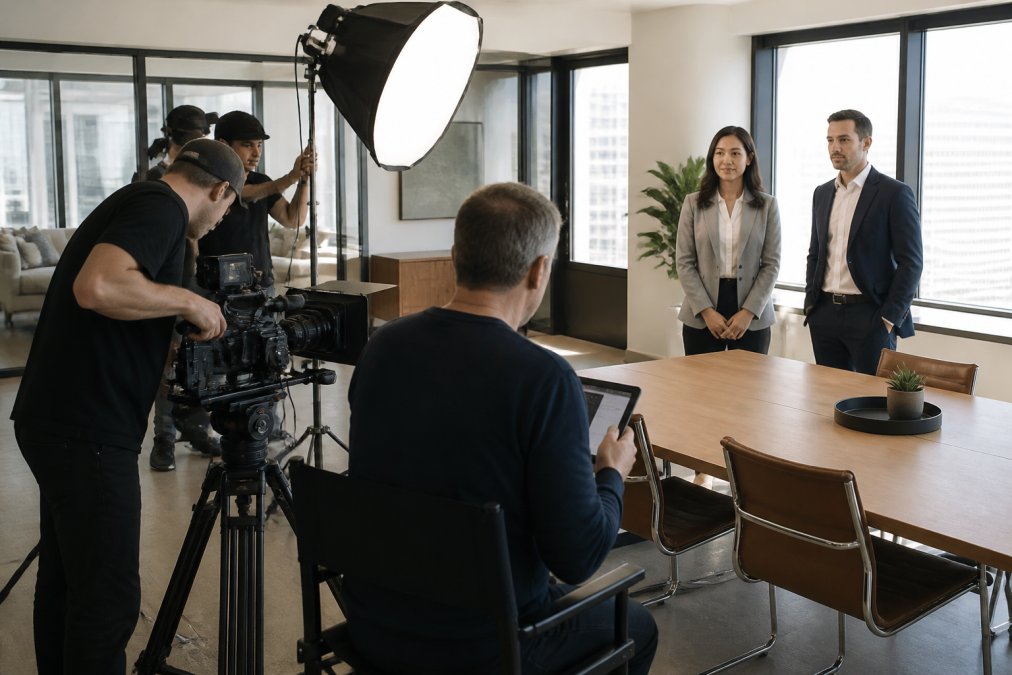
Quality rarely fails on shoot day. It fails in pre-production, when the creative strategy is thin or the shot list is rushed. Protect production quality by locking the script and storyboard before anyone books a crew.
Three practices separate polished work from generic content:
- Lock the story first. A strong visual narrative beats expensive gear every time.
- Shoot for the edit. Capture coverage and B-roll, not just the hero shots.
- Review in stages. Approve rough cuts before color and sound, not after.
What most guides miss is the value of a pre-production day. Spending one day aligning creative direction with your team saves far more than it costs.
Technical Workflow Comparison: From Pre-Production to Post
Most comparison content stops at reel quality and never explains how the two shops actually move a project from brief to final file. That workflow difference is the real decision driver, because it determines your schedule, your revision exposure, and how much of the project lands on your team’s plate. Here is the stage-by-stage breakdown.
Stage 1, Discovery and creative brief. A director-led shop typically compresses discovery into one or two working sessions with the person who will direct the shoot.
Ask any vendor to walk you through their post-production handoff. The shops that can explain exactly where files move between editing, color, and sound are the ones that rarely miss a deadline. A vendor who cannot describe that handoff in specific terms is likely improvising it on your project.
ROI and Business Impact: Measuring the Value of Your Production
Measuring ROI on corporate video means tracking business impact, not view counts. A brand film that drives qualified leads outperforms a viral clip that sells nothing.
Track these metrics against your production spend:
- Pipeline influence: deals that touched the video before closing
- Engagement time: average watch duration on your landing page
- Conversion lift: form fills or demo requests on pages with video
- Sales enablement: how often reps actually use the asset
Nielsen research on video advertising effectiveness
Frequently Asked Questions
What should I look for when hiring a corporate video production company?
Look for a team with experience in your industry, a clear pre-production process, and samples that match the tone you want. Ask about crew size, equipment, and who handles editing. Confirm the timeline in writing and check whether the quote includes scripting, casting, and revisions. A collaborative approach matters more than a long client list.
How do I compare video production agencies for business projects fairly?
Compare agencies on the same brief. Send each one your goals, timeline, and budget range, then review how they respond. Look at creative direction, production quality, and how they handle feedback. Ask for a sample reel and a project timeline. Pricing depends on scope, so treat quotes as estimates until the deliverables are defined.
What is the typical cost of professional corporate video production?
Costs vary widely by scope, crew size, location count, and post-production needs. A simple interview-based video costs less than a multi-day shoot with aerial drone work and motion graphics. Pricing depends on quantity, dates, and delivery, so request a quote based on your specific project instead of relying on generic ranges.
How does BLACKWATER Promotions differ from other production agencies?
BLACKWATER Promotions focuses on corporate film and photography with a collaborative process. The team works closely with clients to define creative strategy, keep production efficient, and deliver content that fits the brand. Their portfolio includes award-recognized work and clients like Kellogg Conference Hotel and Bassett’s Ice Cream.