


Lifimediaproduction Alternative for Corporate Video in 2026
Table of Contents
- Why Marketing Directors Look Beyond Lifimediaproduction for Corporate Video
- How to Choose a Video Production Agency: 7 Evaluation Criteria
- Top Lifimediaproduction Alternatives for Corporate Video Production
- Epipheo: Animated Storytelling and Explainer Videos
- Vidico: Scalable Live-Action for Growing Brands
- Awesomic: Subscription Video Editing for High-Volume Teams
- BLARE Media: High-End Commercial Cinematography
- BLACKWATER Promotions: Corporate Film and Photography Under One Roof
- A Note on Niche-Specific Requirements
- Corporate Video Production Cost: What Actually Drives the Number
- Corporate Video Production Best Practices That Protect Your Budget
- Common Mistakes When Switching Corporate Video Vendors
- Conclusion: Choosing the Right Corporate Video Partner
- Frequently Asked Questions
Last Updated: September 13, 2026
Why Marketing Directors Look Beyond Lifimediaproduction for Corporate Video
Marketing directors rarely leave a production partner because the work was bad. They leave because the process stopped fitting the business. A corporate video is a capital asset, not a one-off purchase, and the vendor you pick in 2026 will shape how your brand looks on screen for years (ana.net). When timelines slip, when every revision triggers a new invoice, or when the finished film feels generic, the relationship quietly ends.
This guide from BLACKWATER Promotions maps the alternatives marketing teams actually evaluate, the criteria that separate a good fit from an expensive mistake, and the workflow questions that prevent surprises. The Association of National Advertisers 2025 member guidance on agency evaluation makes the same point from the client side: fit and process discipline matter more than showreel polish.
How to Choose a Video Production Agency: 7 Evaluation Criteria
Choosing a video production agency comes down to seven checks: portfolio depth, discovery process, creative direction fit, production workflow, post-production turnaround, distribution planning, and total cost transparency. Score each vendor against all seven before you shortlist.
Most teams evaluate two or three. That’s the mistake. A vendor can be brilliant at cinematography and hopeless at project management, and you won’t discover that until week four.
| Criterion | What to Check | Red Flag |
|---|---|---|
| Portfolio depth | Three or more projects in your industry | Only sizzle reels |
| Discovery process | Structured brief and stakeholder interviews | Quote before questions |
| Creative direction | Named director or creative lead | Unnamed “the team” |
| Production workflow | Written schedule with milestones | Verbal timelines |
| Post-production turnaround | Defined revision rounds and delivery dates | “We’ll see how it goes” |
| Distribution planning | Cutdowns, aspect ratios, caption files | Single master file only |
| Cost transparency | Line-item scope and change order policy | One lump-sum number |
Portfolio Depth and Case Study Verification
Ask for full case studies, not clips. A real case study names the client challenge, the production approach, and the outcome. If the vendor can’t show three projects comparable to yours in scale and audience, you’re funding their learning curve.
Discovery Process and Creative Direction Fit
The best vendors interview your stakeholders before they quote. That discovery phase shapes scripting, conceptualization, and creative direction, and it’s the best predictor of whether the final film feels authentic to your brand. Skip it and you get something technically competent and emotionally flat.
Top Lifimediaproduction Alternatives for Corporate Video Production
The strongest alternatives fall into four buckets: animation-led storytelling, scalable live-action, subscription editing, and high-end commercial cinematography. Your brief determines which bucket fits, and the bucket matters more than the brand name inside it.
Use this decision framework before you shortlist. It’s the step most teams skip, and the reason two vendors in the same bucket produce wildly different results.
| If your brief looks like this | The bucket that fits | What to verify before you sign |
|---|---|---|
| Complex, abstract, or hard-to-film messaging; explainer or training content | Animation-led storytelling | Scriptwriting depth, revision rounds, voiceover and music licensing terms |
| Ongoing brand and product content across web and social | Scalable live-action | Project management structure, stakeholder visibility, per-deliverable scope |
| High-volume social and internal content on a steady cadence | Subscription editing | Turnaround SLA, number of active requests, file handoff and source-file policy |
| Flagship brand film or broadcast-grade commercial | High-end commercial cinematography | Crew size, insurance and permitting, color and sound finishing, usage rights |
Epipheo: Animated Storytelling and Explainer Videos
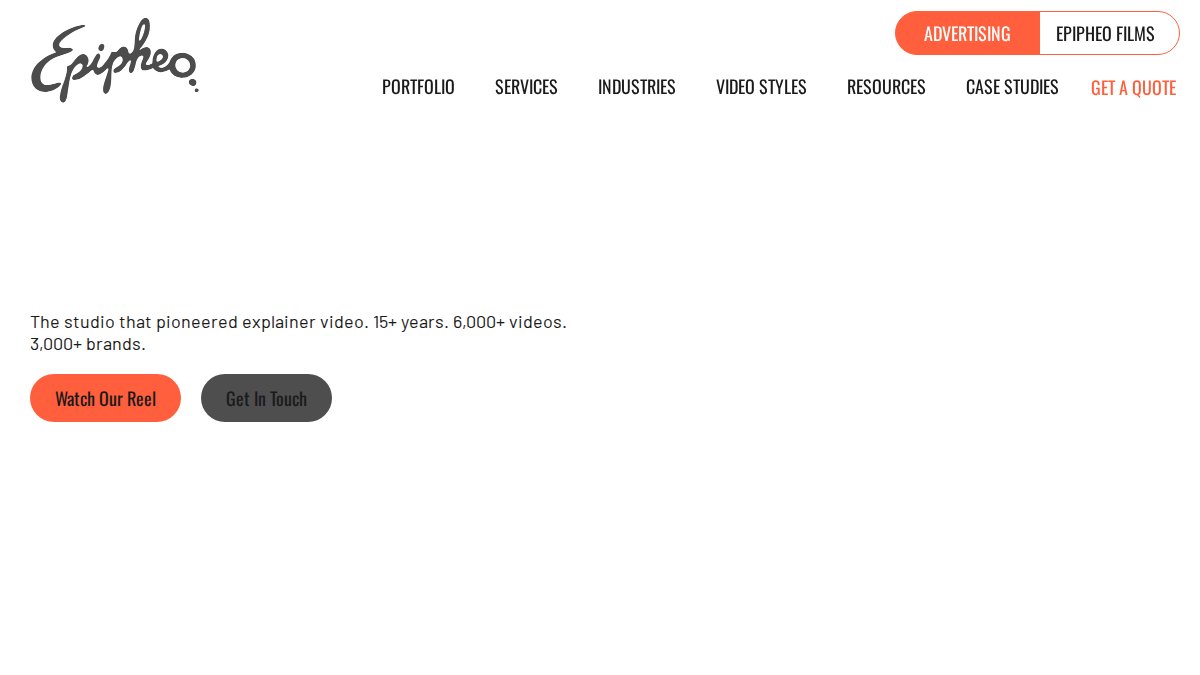
Epipheo builds animated explainers and brand stories, with a track record that includes work for Google. Best for complex messaging that needs simplifying.
Pros: Strong narrative development, expert scriptwriting.
Cons: Heavily weighted toward animation, so live-action cinematography is not the strength.
Match it to your brief if: your subject is abstract, regulated, or hard to film, software, financial products, internal process training, and the message has to land in 60 to 90 seconds.
Vidico: Scalable Live-Action for Growing Brands
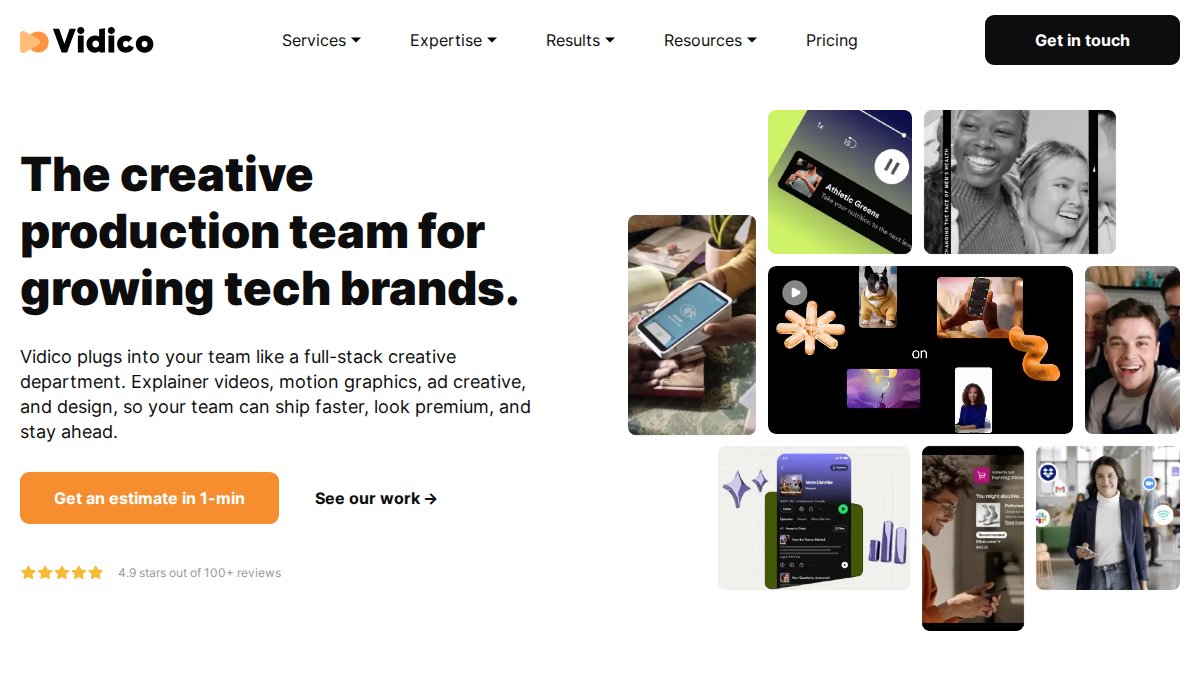
Vidico runs structured, end-to-end production for growing brands and tech companies, covering live-action and motion graphics. Project management is transparent, which matters when multiple stakeholders need visibility.
Pros: Handles diverse styles, clear communication process.
Cons: Scope complexity pushes cost up quickly.
Match it to your brief if: you need a repeatable content engine, multiple videos per quarter, consistent look, and a single point of contact who can report status to your team.
Awesomic: Subscription Video Editing for High-Volume Teams
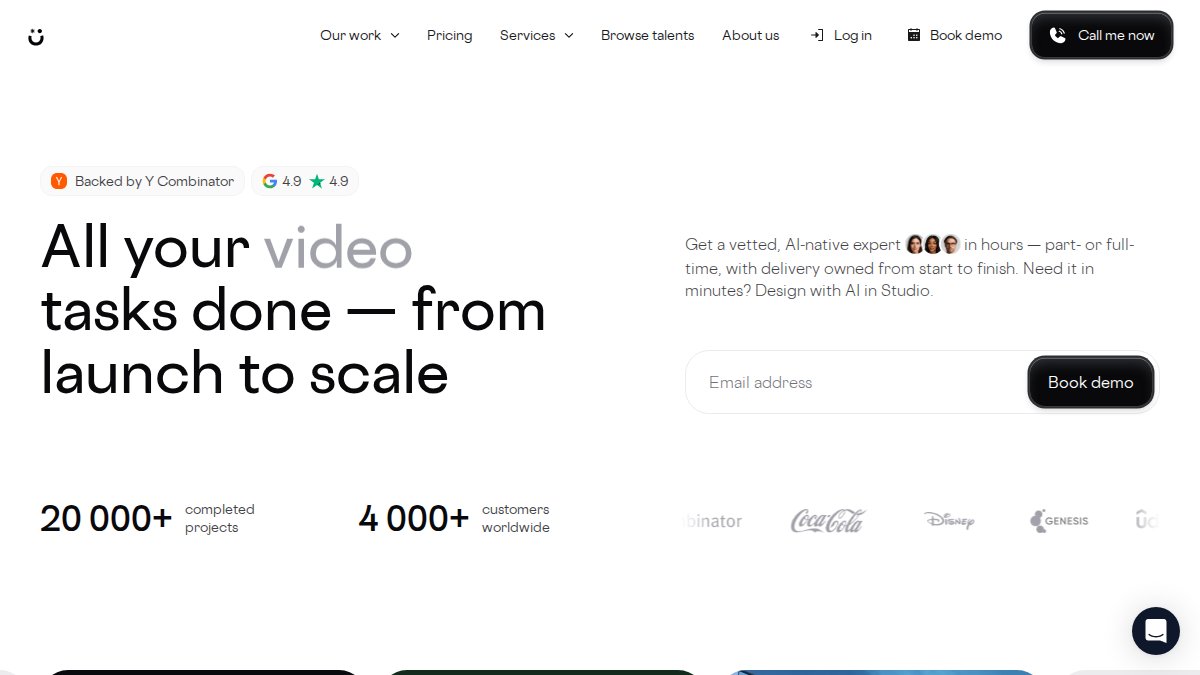
Awesomic sells a monthly subscription with a dedicated creative team and fast turnaround. It suits teams producing steady social and internal content rather than one flagship film.
Pros: Predictable monthly cost, quick delivery.
Cons: Limited long-form creative development compared with a boutique house.
Match it to your brief if: you already have raw footage, a defined brand system, and a backlog of edits, not if you need concept development from scratch.
BLARE Media: High-End Commercial Cinematography
BLARE Media handles large-scale commercial and corporate film work with full crews, equipment, and post-production editing and color grading. Best for organizations needing broadcast-grade production value.
Pros: High production quality, experience with complex multi-day shoots.
Cons: Higher entry cost than independent teams.
Match it to your brief if: the video is a flagship brand asset, a national campaign, an investor film, a product launch, where production value is the point.
BLACKWATER Promotions: Corporate Film and Photography Under One Roof
BLACKWATER Promotions covers corporate film and photography in a single engagement. Your brand video, executive headshots, event coverage, and architectural or food photography come from one creative direction, so visual identity stays consistent across every channel.
The collaborative approach starts at discovery: our team works with your stakeholders to shape the concept, then runs an efficient production process with clear milestones. You get customized creative solutions rather than a template, plus project management that keeps timelines honest.
Pros: Film and photography under one roof, collaborative development, fast and efficient production.
Cons:
Mid-market marketing directors who need corporate film, executive portraits, and event coverage from a single partner with consistent creative direction.
A Note on Niche-Specific Requirements
Most vendor roundups treat every corporate video as the same product. They are not. A safety or instructional video has different requirements than a brand commercial, and the vendor that excels at one may be wrong for the other.
- Safety and instructional video: accuracy and legal review matter more than cinematic polish. Look for vendors who can work with subject-matter experts, version content for regulatory updates, and deliver captioned, chaptered files for LMS platforms.
- Brand and commercial video: emotional resonance and production value drive the result. Look for named creative leads, story development, and color and sound finishing.
- Recruiting and culture video: authenticity beats polish. Look for documentary-style interview experience and the ability to make non-actors comfortable on camera.
Matching the vendor to the video type is the highest-leverage decision in this process. A boutique that has shot twenty safety videos will usually outperform a commercial house on your safety video, even with a smaller showreel.
Corporate Video Production Cost: What Actually Drives the Number
Corporate video production cost is driven by five variables: shoot days, crew size, locations, animation or VFX, and the number of deliverable versions. None is fixed, which is why two quotes for the same brief can differ dramatically.
Pricing depends on scope, dates, and delivery requirements, so treat any ballpark as a starting conversation. Ask every vendor to break their number into pre-production, production, post-production, and licensing. A lump sum hides where the money goes and makes change orders painful.
The U.S. Small Business Administration guidance on evaluating vendor contracts is worth reading before you sign: clear scope definitions and change-order terms protect both sides.
The DIY vs. Agency Decision: An Objective Framework
Most content on this topic is written by agencies, so it conveniently concludes you should hire an agency. Here is the honest version.
In-house production makes sense when all of the following are true:
- You produce video on a continuous cadence, roughly monthly or more, so the fixed cost of equipment and staff is amortized across many projects.
- Your content is simple in format: talking-head interviews, screen recordings, event recaps, internal updates.
- You have at least one person whose primary job is video, not a marketing generalist doing it between other tasks.
- Turnaround is measured in days, not weeks, and you cannot wait on an external queue.
Outsourcing makes sense when any of the following are true:
- The video is a flagship asset, a brand film, a product launch, an investor presentation, where production value is the point.
- The project requires skills you do not have on staff: cinematography, color grading, motion graphics, sound design, professional voiceover.
- The scope is large enough that coordinating it internally would pull your team off revenue work for weeks.
- You need a consistent visual identity across film, photography, and events, which is hard to maintain with a rotating cast of freelancers.
The middle path, a hybrid, is the most common pattern among mid-market teams. Keep a lean in-house capability for fast, simple content, and bring in an external partner for flagship work and specialized craft. It’s usually cheaper than either extreme: you’re not paying agency rates for content a phone and ring light can handle, or staff salaries for work that happens twice a year.
The Hidden Costs Nobody Quotes You
The line items that blow up budgets are rarely the shoot itself:
- Reshoot days. A single script change after the shoot can trigger a full crew day. This is the most expensive line item on any production invoice, and it is almost always avoidable with a locked script.
- Licensing. Music, stock footage, and talent usage rights are frequently quoted separately. A track that is free for web may cost more for paid media or broadcast.
- Versioning. Every additional aspect ratio, caption file, or cutdown adds post-production hours. If you need a 16:9 master, a 9:16 vertical, a 1:1 square, and a 30-second cutdown, say so before the quote, not after.
- Rush fees. Compressing a normal post-production timeline into half the time usually carries a premium. Planning around standard turnaround is one of the easiest ways to save money.
Post-Production Turnaround: What to Actually Expect
Turnaround is the pain point clients complain about most, and it’s rarely discussed in vendor marketing. Benchmarks vary by project type, but a common pattern is:
- Simple social edits from existing footage: days, not weeks.
- Short-form brand or product video with a defined script: a few weeks from shoot to final delivery, including revision rounds.
- Flagship brand film with animation, color, and sound finishing: several weeks to a few months, depending on complexity and the number of stakeholder review cycles.
The variable that most often extends a timeline is client-side review, not the vendor. Every additional approval layer adds days. If your organization requires legal, executive, and brand review, build that into the schedule before you sign, and ask the vendor to define how many revision rounds are included and what happens when you exceed them.
The cheapest quote is rarely the cheapest project. Compare vendors on total cost of ownership, shoot days, revision rounds, licensing, versioning, and turnaround, not on the headline number.
Corporate Video Production Best Practices That Protect Your Budget
Three practices consistently protect budgets: lock the script before the shoot, batch deliverables into one production, and specify usage rights in writing.
A common mistake is treating the script as a draft until the edit bay. Every change after shooting means reshoots or awkward fixes. Approve the script, shot list, and storyboard first, then let the crew work.
Batch related needs into a single production window. If you need a brand film, executive headshots, and event coverage this year, one coordinated shoot costs less than three separate engagements and produces a more consistent look.
Finally, confirm music licensing and talent usage terms up front. Licensing surprises are the most common hidden cost in post-production.
Skipping the script lock is the fastest way to blow a budget. A single line change after the shoot can trigger a reshoot day, and reshoot days are the most expensive line item on any production invoice.
Common Mistakes When Switching Corporate Video Vendors
The most common mistake is switching vendors to save money without changing the brief. If the scope stays identical and only the price changes, you’ll get a cheaper version of the same result.
Other repeat offenders:
- Choosing on showreel alone, without checking whether the vendor has worked at your scale
- Skipping the discovery phase to move faster, then paying for it in revisions
- Failing to request project files and raw footage in the contract, which locks you to one vendor
- Ignoring post-production turnaround benchmarks, then missing a launch date
- Forgetting distribution: a single master file won’t cover social, web, and internal channels
Ask for the raw footage and project files in the original contract. Vendors who refuse are telling you something important about how they view the relationship.
Conclusion: Choosing the Right Corporate Video Partner
The hardest part of switching vendors isn’t finding options. It’s finding a partner whose process matches how your team actually works, and who can carry your brand identity across film, photography, and events without dropping quality.
BLACKWATER Promotions handles corporate film and photography under one roof, runs a collaborative discovery process, and delivers customized creative solutions with efficient, well-managed production timelines. If you’re evaluating alternatives and want a partner who treats your brand story as the brief, let’s talk.
Frequently Asked Questions
What should I look for when hiring a corporate video production company?
Look for a portfolio that matches your industry and video style, a clear discovery process, and a production timeline you can verify. Ask how they handle scripting and conceptualization, who owns the final files, and whether post-production editing revisions are included. Request two or three references from clients your size. A corporate video production partner should also explain how the final asset supports your video marketing strategy and distribution plan, not just the shoot day.
How much does professional corporate video production cost?
Corporate video production cost depends on scope: number of shooting days, crew size, animation versus live action, location count, and post-production complexity. A simple talking-head video costs far less than a multi-location brand film with cinematic storytelling. Rather than quoting a flat figure, ask each agency to itemize pre-production, production, and post-production editing separately. Request a written scope so you can compare bids on equal terms before committing your video investment.
How do I compare different corporate video production companies?
Build a shortlist of four or five agencies, then score each on portfolio relevance, creative direction, project management process, turnaround time, and communication style. Request a sample edit or a short creative treatment, not just a reel. Check whether they offer end-to-end production or outsource parts of the workflow. Ask for a production timeline with milestones. Comparing agencies on the same criteria keeps the decision objective instead of swayed by a polished sales pitch.
What is the typical timeline for a corporate video production project?
Most corporate video projects run four to eight weeks from kickoff to final delivery. Scripting and conceptualization take one to two weeks, scheduling and the shoot take another one to two, and post-production editing with two revision rounds takes two to three. Animated videos and multi-location shoots run longer. If you need content in six weeks, confirm the post-production turnaround time in writing before signing, and ask what happens if a shoot day gets rescheduled.
Does my business need a local or national video production agency?
It depends on shoot locations and how much on-site collaboration you want. A local agency simplifies logistics for multi-day shoots at your office, restaurant, or property site. National agencies work well for animated explainers, remote interviews, and internal communications video where travel is minimal. Many mid-market companies use a regional partner for live-action corporate video production and a national or subscription service for recurring social and internal content.