

Aerial Videography for Real Estate: A 2026 Guide
Table of Contents
- Why Aerial Videography Matters for Property Listings
- Real Estate Drone Video Pricing: What to Budget
- FAA Part 107 Requirements for Real Estate Drone Operations
- Essential Equipment for Aerial Videography in Real Estate
- Drone Videography Tips for Property Listings That Convert
- Post-Production and Video Editing for Maximum Impact
- How to Choose a Professional Drone Service vs. DIY
- Conclusion
- Frequently Asked Questions
Last Updated: September 4, 2026
Buyers scroll past listings that lack visual impact, and aerial videography for real estate has become the standard tool for stopping that scroll. A single sweeping shot that reveals a property’s roofline, acreage, and neighborhood context in motion does what a dozen still photos cannot. This guide from BLACKWATER Promotions breaks down what the service entails, the FAA Part 107 requirements that govern it, and the equipment and techniques that produce footage worth the investment.
The core insight is simple: aerial videography for real estate is no longer a luxury add-on but a competitive necessity for agents and developers who want faster sales at better prices. Below, we’ll show you exactly how to plan, execute, and edit drone footage that converts viewers into buyers. We’ll also cover when hiring a professional makes more sense than flying a drone yourself, and how to budget realistically for either path.
Why Aerial Videography Matters for Property Listings
Aerial video gives buyers an instant sense of scale and setting that ground-level photography cannot match. When you see a property from above, you understand its true acreage, the layout of outbuildings, the flow of the driveway, and how the home sits within its neighborhood context. That aerial perspective answers buyer questions before they ask them.
The practical effect on marketing is measurable. Listings with high-definition aerial footage tend to hold viewer attention longer and generate more inquiries because they tell a complete visual story. Aerial videography for real estate also builds curb appeal at a macro level, showing landscaping, pool placement, and outdoor living spaces as integrated features rather than separate shots.
The most effective aerial sequences are not the highest or the fastest. Slow, deliberate passes at lower altitude that reveal the property’s relationship to its surroundings produce footage that feels cinematic and intentional.
Real Estate Drone Video Pricing: What to Budget
Pricing for professional drone work varies widely based on location, property size, and the complexity of the shoot. A standard package for a single residential property typically includes a defined flight window, multiple takes, and edited deliverables, while larger estates or commercial developments require more flight time and more involved post-production.
For agents weighing real estate drone video pricing, the deciding factors are turnaround time, the number of properties covered per shoot, and whether the provider includes color grading and music licensing in the final edit. Many professionals offer bundled packages that combine aerial footage with ground-level photography for a more efficient per-listing cost.
Rather than quoting a single figure, most reputable providers structure pricing per project based on your specific needs. The best approach is to request a detailed quote that itemizes flight time, editing hours, and deliverable formats so you can compare options on an apples-to-apples basis. For current market rates and package structures, consult a professional service directly.
FAA Part 107 Requirements for Real Estate Drone Operations
Commercial drone work in the United States falls under FAA Part 107 regulations, which govern the operation of unmanned aircraft systems for business purposes (faa.gov). Aerial videography for real estate is considered a commercial operation, so you must hold a Remote Pilot Certificate before flying for any listing.
The certification process requires passing a knowledge test at an FAA-approved testing center, which covers airspace classification, weather effects on flight, and emergency procedures (faa.gov). Operators must also register their aircraft with the FAA and pass a background check through the Transportation Security Administration. FAA Part 107 rules for commercial drone operators require that the drone remain in visual line of sight at all times and that flights stay below 400 feet unless special authorization is granted.
Flying a drone for a real estate listing without a Part 107 certificate carries significant penalties, including fines that can reach into the thousands of dollars per incident. Insurance providers may also deny coverage for unlicensed commercial flights.
Beyond the certificate, operators must request airspace authorization when flying near controlled airports. Tools like the FAA’s LAANC system allow for near-instant approval in many areas, but planning ahead is essential. A commercial drone pilot working regularly in real estate should also carry drone insurance to protect against property damage or personal injury claims during shoots.
Essential Equipment for Aerial Videography in Real Estate
The right drone makes the difference between footage that looks professional and footage that looks amateur. For real estate work, the camera sensor matters more than almost any other specification, because it determines dynamic range, low-light performance, and the ability to capture clean detail in shadows and highlights.
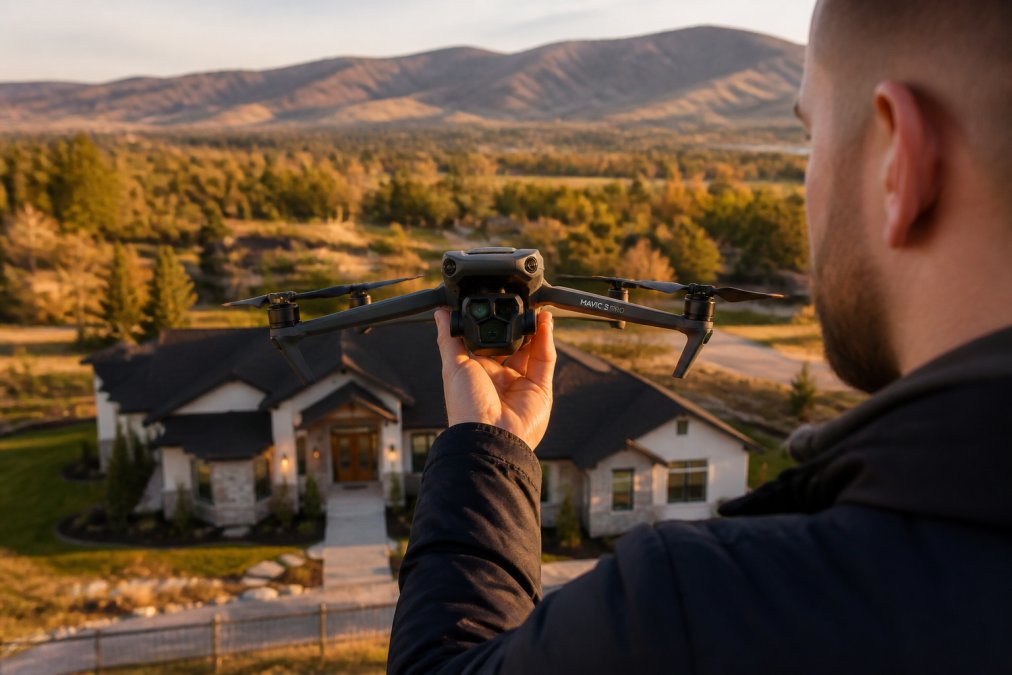
The DJI Mavic 3 Pro, starting around $2,199, leads the category with a triple-camera system that includes a Hasselblad 4/3 CMOS sensor. That larger sensor captures the kind of image quality that holds up in large-format marketing and on high-resolution screens, and its 43-minute maximum flight time means fewer battery changes on a multi-property shoot. The omnidirectional obstacle sensing is a genuine safety net when flying close to rooflines and trees.
For agents who want a more portable option, the DJI Mini 4 Pro at $759 delivers 4K/60fps HDR video in a sub-250g frame. Because it weighs under 250 grams, it falls into a simplified regulatory category, though Part 107 still applies for commercial use. Its compact size makes it easy to keep in a trunk for impromptu listing shoots, though it offers less wind resistance than larger models.
Between those two sits the DJI Mavic 3 Classic at $1,469, which pairs the same Hasselblad 4/3 CMOS sensor with a 46-minute flight time but drops the extra telephoto lenses. For photographers who prioritize color science and don’t need the zoom range, it represents a strong value. Regardless of which model you choose, a gimbal stabilization system is non-negotiable for smooth, professional footage.
| Drone Model | Starting Price | Best For | Key Tradeoff |
|---|---|---|---|
| DJI Mavic 3 Pro | $2,199 | Professional quality and versatility | Higher initial investment |
| DJI Mini 4 Pro | $759 | Portability and regulatory ease | Less wind resistance |
| DJI Mavic 3 Classic | $1,469 | Sensor quality without extra lenses | No telephoto capability |
Drone Videography Tips for Property Listings That Convert
Capturing footage that converts requires more than pointing the camera at the house. The most effective aerial videography for real estate follows a deliberate flight path that reveals the property in a logical sequence, starting with the approach and neighborhood context before closing in on architectural highlights.
Flight Planning and Camera Settings
Plan your flight path before you launch. Use flight planning software to map out the key shots: a nadir shot directly above the property for full context, oblique angles at 30 to 45 degrees that show both roof and facade, and a slow push-in toward the front entrance. This sequence creates a visual narrative that mirrors how a buyer would approach the home in person.
Set your camera to manual mode rather than relying on auto exposure. Fixed exposure settings prevent the sky from blowing out or the home’s facade from falling into shadow as the drone pans across different light conditions. For 4K resolution delivery, record at 24 or 30 frames per second for a cinematic look, and keep shutter speed at roughly double your frame rate to maintain natural motion blur.
Composition Techniques and Visual Storytelling
The most common mistake in real estate drone work is flying too high and too fast. Aerial footage should feel like a guided tour, not a flyover. Keep the property prominent in the frame and use the surrounding landscape as context rather than the subject itself. Automated flight modes on modern drones can execute smooth orbits and waypoint flights, but manual control often produces more intentional framing.
Visual storytelling means showing the property highlights in order of impact: the approach, the roofline, the outdoor living spaces, and the acreage boundaries. Each shot should last long enough in the final edit for a viewer to absorb the detail. When you integrate this footage with a 3D virtual tour, buyers can move seamlessly from an exterior overview to an interior walkthrough, which keeps them engaged with the listing longer.
Post-Production and Video Editing for Maximum Impact
The footage you capture in the field is raw material; the edit is where aerial videography for real estate becomes a finished marketing asset. Post-production involves selecting the best takes, stabilizing any subtle camera movement, and assembling the shots into a sequence that builds toward the property’s strongest features.
Color grading is particularly important for aerial footage because the camera often captures a wider dynamic range than the final video displays. A consistent grade across all clips ensures the sky, landscaping, and architecture look natural and cohesive. Most professional editors also add subtle motion to static shots, such as a slow zoom or pan, to keep the video visually engaging throughout.
Music selection is another factor that separates professional listings from DIY efforts. The right track sets the emotional tone, whether that is an upbeat rhythm for a modern condo or a calm acoustic piece for a rural estate. Ensure any music you use is properly licensed for commercial use to avoid copyright issues.
A 60-to-90-second final edit is the sweet spot for most property listings. It is long enough to tell the full story of the property but short enough to hold attention across [social media platforms](/the-importance-of-social-media-video-marketing-for-your-business/) and listing sites.
How to Choose a Professional Drone Service vs. DIY
The DIY route makes sense for agents who shoot multiple listings per month and are willing to invest in the equipment, the Part 107 certification, and the editing time. Owning a drone and mastering the workflow gives you full control over scheduling and eliminates per-project costs. The tradeoff is the upfront investment and the ongoing responsibility for regulatory compliance and equipment maintenance.
Hiring a professional service makes sense when you need guaranteed quality, fast turnaround, or coverage of a large or complex property. A professional commercial drone pilot brings experience in flight planning, airspace authorization, and post-production that produces consistent results. For agents who value their time over the cost of outsourcing, this is often the more efficient path.
The decision also depends on the scale of your operation. An agent selling one or two homes per month will rarely justify the cost of a high-end drone and the hours spent editing. A developer marketing an entire community, by contrast, needs aerial videography for real estate across multiple phases and properties, which makes a dedicated professional relationship more practical.
When you do hire out, look for a provider with verifiable Part 107 certification, a portfolio of real estate work, and clear deliverables. Ask about turnaround time, editing revisions, and whether they handle airspace authorization. For agents seeking a partner who understands both the technical and marketing sides of the work, a full-service production team offers the most simplified experience.
Conclusion
Aerial videography for real estate has shifted from a differentiator to an expectation among serious buyers. Whether you choose to master the craft yourself or partner with professionals, the properties that sell fastest will be the ones presented with the clearest and most compelling visual story.
The challenge is execution: navigating FAA Part 107 requirements, selecting the right equipment, and producing footage that converts requires genuine expertise. At BLACKWATER Promotions, our team combines a collaborative approach to project development with an efficient, fast production process, delivering customized creative solutions that make your listings stand out. From aerial video to full brand storytelling, we handle the production so you can focus on the sale.
Get started with BLACKWATER Promotions and elevate your property marketing with professional aerial footage that drives results.
Frequently Asked Questions
How much does professional aerial videography for real estate cost?
Pricing for real estate drone video services depends on property size, video length, editing complexity, and location. Service providers typically charge per project rather than hourly rates. For specific pricing from BLACKWATER Promotions, request a quote based on your property’s unique needs and desired deliverables. Market rates vary significantly by region and service level.
What are the FAA Part 107 requirements for real estate drone flights?
Commercial drone operations, including real estate videography, require an FAA Part 107 certificate. Pilots must pass a knowledge test, maintain visual line of sight, stay below 400 feet, and avoid flying over people or populated areas. Drones must weigh under 55 pounds. Part 107 also restricts night flights and requires airspace authorization in controlled areas. Hiring a certified commercial drone pilot ensures compliance.
What equipment do I need for high-quality aerial videography?
Professional-grade drones like the DJI Mavic 3 Pro ($2,199) offer 4K resolution, gimbal stabilization, and advanced flight safety features. The DJI Mini 4 Pro ($759) provides excellent portability and video quality for budget-conscious operators. Beyond the drone, you’ll need ND filters for exposure control, extra batteries, a flight planning software, and editing tools. Professional services handle all equipment and technical requirements.
How does aerial video impact property listing conversion rates?
Aerial footage provides neighborhood context, showcases property boundaries, and highlights landscaping and architectural features that ground-level photos miss. Properties with drone videography typically spend less time on the market and attract more qualified buyers. The visual storytelling aspect helps buyers envision the property’s full potential and location advantages, directly influencing listing conversion rates.
Do I need a licensed pilot for real estate drone photography?
Yes. Commercial real estate drone work requires an FAA Part 107 certificate from the pilot. This involves passing a knowledge test and meeting experience requirements. Hiring a professional service like BLACKWATER Promotions ensures your aerial videography is captured by a certified, insured pilot who understands both technical and regulatory requirements.